
Fayette County Release Meanings
Leaving the Fayette County Jail does not always mean returning to the community. A person may post bond, finish a sentence, receive a court-ordered release, transfer to the Georgia Department of Corrections, or move to another agency because of a hold. The live Sheriff's inmate lookup is built for current inmates and recent bookings. Once a name vanishes, absence is only a clue. A spelling mismatch, data lag, court movement, transfer, or release can produce the same result.
A bond release ends the jail stay while the case may continue. Time served means the credited custody time satisfies the ordered jail term. A discharge ends the relevant correctional custody or sentence status. Parole permits release from prison under conditions, while probation is court-ordered supervision that may follow jail or replace incarceration. A detainer is another agency's request affecting where the person goes next.
| Outcome | Meaning | Next record |
|---|---|---|
| Bond | Release pending later court action | Jail record and court docket |
| Time served | Ordered jail time completed | Release record and disposition |
| GDC transfer | County custody changes to state custody | GDC offender query |
| Parole or probation | Community supervision follows custody | Parole Board or DCS |
| Agency transfer | Another jurisdiction assumes custody | Receiving agency locator |
Fayette County Release Record Fields
The county's public lookup shows booking data, not a complete public release record. Visible fields include identity details, booking number and date, court, charges, and bond. Jail or records staff may maintain the release date and time, reason, bond type, court order, destination, transfer agency, lifted hold, or administrative code. Those release-specific items were not visible in the public lookup reviewed, so request the record rather than assuming the roster supplies them.
| Field | What it establishes |
|---|---|
| Booking number and date | The correct custody episode |
| Court and charge | The case connected to custody |
| Bond | Whether release terms were set |
| Release date and reason | When and why jail custody ended |
| Destination or agency | Community release versus transfer |
State and federal records use other fields. GDC may show sentence data, conviction county, institution, inactive status, maximum release information, and a photograph when available. The BOP locator displays a federal register number, identity fields, location, and release date. A court docket may show the bond, plea, dismissal, sentence, probation order, or other action that explains the custody change.
Request Fayette County Release Records
The Sheriff's Support Services Division accepts open-records requests electronically, in person, or by mail. Direct correspondence to Lieutenant Nathaniel Huddleston, Attn: Open Records Request, 155 Johnson Avenue, Fayetteville, GA 30214. The open-records number is 770-716-4712; Records is 770-716-4790. Describe the named person, booking number if known, approximate custody dates, and the release or transfer fields sought.
- Check the jail lookup and save the booking number, court, and booking date.
- Ask for the booking and release record for that exact custody event.
- Specify whether the request includes bond, release reason, time, destination, or transfer agency.
- Use the court docket and receiving-agency record to reconcile the response.
Georgia's Open Records Act, O.C.G.A. 50-18-70 et seq., governs inspection and production. An agency need not create a record that does not exist, and exemptions may require withholding or redaction. The framework generally calls for production or a response within three business days. Costs may apply under law. The Sheriff's published fees for other records do not prove a fixed fee for every release request.
A sealed, restricted, juvenile, or otherwise exempt matter may not appear like an ordinary public booking. Record restriction is not the same as destroying every agency record. Fayette's Sheriff provides a restriction form and lists a $25 nonrefundable fee per arrest cycle or offense date. Ask the originating office what remains available in the specific case.
Find Fayette County Released Inmates
Start with the custody level. The county lookup answers whether a locally booked person still appears in the jail data. It does not confirm release through a dedicated release feed. For a state sentence, the GDC query is stronger. For a local court result, use the Clerk's docket. VINE can report custody changes, while federal and immigration systems cover their own populations.
- Search the Fayette lookup using the full name in “FirstName LastName” order and correct spelling.
- If absent, call the Jail Division or request the booking and release record.
- Search the Fayette court docket for bond, disposition, sentence, or transfer activity.
- For state custody, search GDC inactive records and recent releases.
- Check VINE, parole, BOP, or ICE only when that custody path fits.
Georgia Released Offender Search
The Georgia Department of Corrections offender query covers people connected to GDC custody, including Fayette County convictions that led to state imprisonment. It is not the primary record for someone who only bonded out of the county jail. Select “Only Inactive Offenders (Not Currently Incarcerated)” for a past state inmate or search both active and inactive records. “Released In The Past 15 Days” can narrow a recent state release.
Search fields include name, GDC ID, case number, age, gender, race, conviction county, most recent institution, sentence status, offense, aliases, and physical details. “FAYETTE COUNTY JAIL” and “FAYETTE COUNTY CI” appear in the institution list. A unique ID is safer than a common name. GDC warns that its online information may be incomplete and directs verification to Inmate Records and Information, PO Box 1529, Forsyth, GA 31029.
The official query shows the inactive and recent-release choices described above. Open the GDC query source before reviewing the captured form.
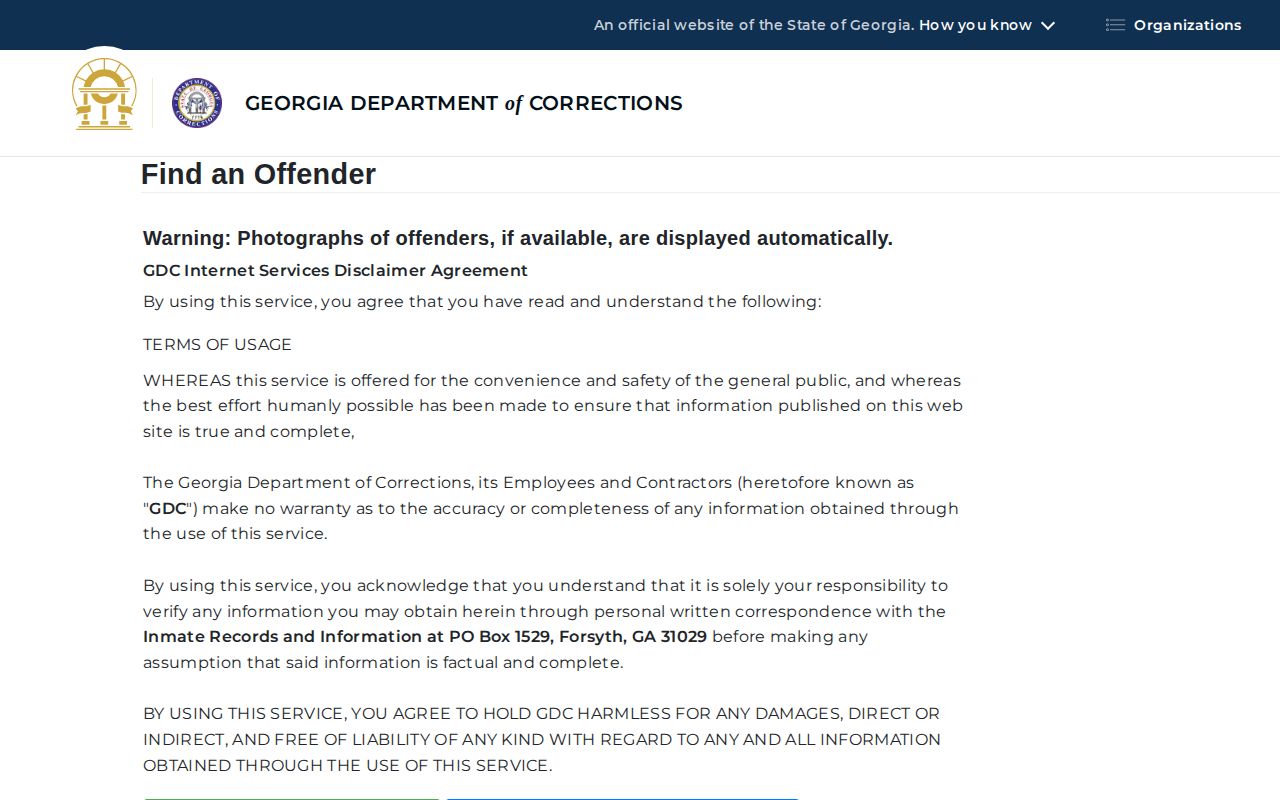
The form's separate scope and sentence-status controls help distinguish a past state inmate from a person still incarcerated.
Fayette County Bond Release Options
Fayette County permits bonds to be handled around the clock, although the Sheriff publishes no general release-time schedule. The Jail Division identifies cash, property, professional, and transfer bonds. Exact cash or a bank-issued certified check is required for a cash bond. Fayette County property and original documents support a property bond. A transfer bond from another county must arrive sealed.
A $20 fee applies to each bond written under the Sheriff's published guidance. Bond is a promise tied to later court appearances, not payment of a fine or a finding that the case is over. The jail release may occur while charges remain pending. Confirm the event through the jail record, then follow the court docket for the continuing case.
Property After Fayette County Release
Release also starts a short property deadline. The Sheriff's Inmate Information page says a released or transferred person has 10 days to arrange release of property. After that point, the property is disposed of. This differs from the rule for a person still held who names someone to collect property, which uses a 30-day admission clock.
Contact the Jail Division promptly if release or transfer has occurred. The rule matters after a GDC or ICE transfer too, because leaving the county building does not itself move stored personal property to the receiving agency.
Fayette Release Court Docket
The Fayette County Clerk online services provide one Court Docket starting point for Superior, State, and Magistrate Courts. Superior Court handles felony charges. State Court handles many misdemeanor and traffic cases. Public docket entries can reveal a bond, sentence, probation order, dismissal, plea, warrant action, or transfer that explains why a person left jail.
Online access is not a full image archive. The Clerk search policy says docket entries are public, but document images cannot be viewed. Printed court notices control when online case-status information conflicts. For copies or clarification, contact the proper clerk rather than inferring the result from a short entry.
Fayette Release Supervision Checks
Parole decisions come from the State Board of Pardons and Paroles, while the Georgia Department of Community Supervision manages much community supervision. A Tentative Parole Month is a review month, not proof of release. After release, the parolee database and DCS office route are more relevant. Fayette is served by the Griffin DCS field office. Local State Court misdemeanor probation may instead involve Judicial Correction Services.
Georgia VINE offers confidential custody-status and case notifications. The Parole Board's V.I.P. hotline, 1-800-593-9474, can provide registered users with custody, parole status, maximum or scheduled release information, and a not-in-custody indication. These alerts support a status check, but a certified jail, GDC, or court record remains the stronger documentary source. See Probation & Parole and VINELink Inmate Search.
ICE Transfers After Fayette Release
The Fayette County Jail publishes quarterly immigration-detainer reports under O.C.G.A. 41-1-11.4. That local reporting makes one distinction vital: release from the county jail can mean transfer to immigration custody, not return to the community. Do not treat removal from the county roster as proof of freedom.
Ask jail records whether another agency received the person, then use the official ICE Online Detainee Locator System. Counsel or court records may be needed when the locator does not resolve the transfer. A federal sentence follows a different path through the BOP Inmate Locator, where “Released” or “Not in BOP Custody” means only that BOP no longer holds the person.
Fayette Custody Sources Compared
The correct source depends on who held the person and what happened next. Use the narrowest official system first, then verify across records when a transfer is possible.
| Source | Best use | Key limit |
|---|---|---|
| Fayette jail lookup | Current custody and recent bookings | No verified release feed |
| Sheriff records | County booking, release, or transfer record | Request may be required |
| Fayette court docket | Bond and case disposition | No public document images |
| GDC query | State custody and discharge | Not a simple county bond source |
| BOP or ICE locator | Federal or immigration custody | Each covers only its own system |
Fayette County Release Facilities
Five official custody paths may matter to a Fayette search. The first two are local labels; the remaining entries cover statewide, federal, and immigration custody. Follow the facility page that matches the person's actual custody.
- Fayette County Jail, the Sheriff's county jail and local booking source.
- Fayette County CI, a GDC-listed institution label that requires verification.
- Georgia Department of Corrections, for state prison custody and discharge.
- Federal Bureau of Prisons, for federal sentences.
- ICE Online Detainee Locator System, for immigration custody.
Resolve Conflicting Fayette Release Records
Official sources can update on different schedules. First compare the full name, booking number, GDC ID, and court case number. Then place each event in order. A county booking can precede bond, a court sentence, a GDC transfer, and later parole. Each record may be accurate while describing a different point in that sequence.
Call the office responsible for the disputed event. The Jail Division can address its release record. The Clerk can provide court copies. GDC Inmate Records can verify a state offender result. BOP and ICE answer only for their own custody systems. Ask whether the maintained record identifies a release time, reason, or destination instead of asking one office to interpret another agency data.
Keep “not found” separate from “released.” A failed name search can result from spelling, an alias, an older unavailable record, transfer, or public-display limits. Stronger proof is an actual release event, inactive or discharged state status, court disposition, or confirmation from the custodian. Obtain the official copy when the precise event matters.
Fayette Release Verification Details
For a county release, preserve the booking number because one person can have more than one custody episode. Ask the Sheriff for the event tied to the known booking date. The court field on the lookup helps route the next check. Superior Court is central for felony charges, while State Court handles many misdemeanor and traffic cases. Magistrate Court can hold relevant early case entries. The Clerk manages the public docket route for all three.
For state custody, a name-only GDC search can be widened or narrowed with conviction county, most recent institution, sentence status, aliases, age, and physical details. Search both active and inactive records if the current state is uncertain. “Released In The Past 15 Days” is useful only for a recent GDC event. Older inactive records require the broader inactive scope. Written verification with GDC remains important because its disclaimer warns that online data may not be complete.
Notifications answer a different question from records. Georgia VINE can notify a registered user of custody changes. The Parole Board V.I.P. channel can report parole and scheduled-release information for eligible registered users. Neither creates the county booking-and-release document. Use an alert to learn that a change may have occurred, then obtain the official record from the agency responsible for that event.
Fayette Release Request Details
A precise records request begins with the custody episode, not just a name. Fayette public lookup fields can provide the booking number, booking date, court, charge, and bond information. Include those identifiers and an approximate date range. Then ask for existing fields that state when custody ended, the reason for release, and any destination or receiving agency. That wording separates a bond release from transfer to GDC, ICE, the U.S. Marshals, or another county.
The Sheriff accepts open-records requests electronically, in person, and by postal mail. Open-records correspondence is directed to Lieutenant Nathaniel Huddleston, Attn: Open Records Request, 155 Johnson Avenue, Fayetteville, GA 30214. The open-records phone is 770-716-4712, while the Records number is 770-716-4790 and Jail number is 770-716-4720. Georgia law generally calls for production or a response within three business days, but an office need not create a record that does not exist. Exempt material may be withheld or redacted.
Payment details depend on the requested record. The Sheriff publishes ten cents per page for incident reports requested by a person not involved and five dollars per accident-report copy, with no charge to involved people for those categories. Those listed prices do not establish a universal release-record fee. Accepted methods include exact cash, business or certified checks, and money orders payable to the Sheriff. Personal checks are not accepted. Ask the Records Section for the cost tied to the actual responsive release material.
After receiving a record, compare it with the correct next source. A court docket can explain a bond, sentence, dismissal, or probation order. GDC inactive status can document a later state correctional release. BOP covers a federal sentence, while ODLS covers immigration detention. The county record anchors the local exit, but the receiving system controls what happened afterward. Keep a dated copy of each official response for comparison.