
Fayette Projected Versus Actual Release
A projected date is a calculation or forecast. Actual release is the completed custody event. Georgia agencies use several labels that answer different questions. The Georgia Department of Corrections uses a maximum release date, or MRD, for the calculated end of a prison term. The State Board of Pardons and Paroles uses Tentative Parole Month, or TPM, for the month when final parole review may occur. Its V.I.P. service may report a maximum or scheduled release date. The Fayette County Jail's public lookup does not expose a release-date field.
These terms should not be blended. A TPM is not a promised exit date. A maximum date is not necessarily the day someone will leave if parole, credits, a new order, or another hold changes the path. A pretrial detainee has no sentence-based date at all. Bond can permit release while the case continues, but another warrant or detainer can prevent departure.
Find Fayette State Release Dates
For a Fayette conviction that led to state imprisonment, start with the GDC Find an Offender page. The county jail roster cannot calculate or confirm completion of a state prison sentence.
- Identify the system. Use Fayette jail records for a local detainee, GDC for a state prisoner, and BOP for a federal prisoner.
- In GDC, search by name, GDC ID, case number, or conviction county. Compare identity details before opening a record.
- For an active prisoner, review institution and sentence data. Use “Max Prison Term Ending Next 15 Days” when the maximum term is near.
- For a person thought to be out, select inactive offenders or “Released In The Past 15 Days.” An inactive result means not currently incarcerated by GDC, not freedom from every form of custody or supervision.
- If parole may apply, use the Board's TPM Lookup. For an actual release, verify with GDC records, VINE, V.I.P., or the receiving supervision agency.
The Fayette released-inmate search routes names across county, state, and federal systems. Searching the correct custodian first prevents a missing county-jail result from being mistaken for release.
The GDC query form includes extensive identity filters such as race, gender, age, alias, physical details, most recent institution, primary offense, and conviction county. It also supports GDC ID and case-number searches. Those fields help separate people with similar names and connect the displayed date to the right record.
GDC Date Labels for Fayette
The official state form offers sentence-status choices designed for both approaching release and recently completed GDC custody. Use each option for its stated scope.
| GDC or parole label | What it means |
|---|---|
| Maximum Release Date | The calculated end of the state prison term after applicable sentence calculations. |
| Max Prison Term Ending Next 15 Days | A search option for active offenders nearing the maximum term end. |
| Released In The Past 15 Days | A sentence-status filter for recent GDC releases, not county-jail bond releases. |
| Inactive offender | A person not currently incarcerated by GDC. Other custody or supervision may still exist. |
| Tentative Parole Month | The month of final parole review, not a guaranteed release date. |
| Scheduled release date | A date category available through the Board's V.I.P. information channel. |
GDC tells users to verify online information with Inmate Records and Information before assuming it is complete. The office mailing address in the research is PO Box 1529, Forsyth, GA 31029. Use the offender's GDC ID whenever possible.
The official GDC offender query form shown below supports inactive and recent-release searches.
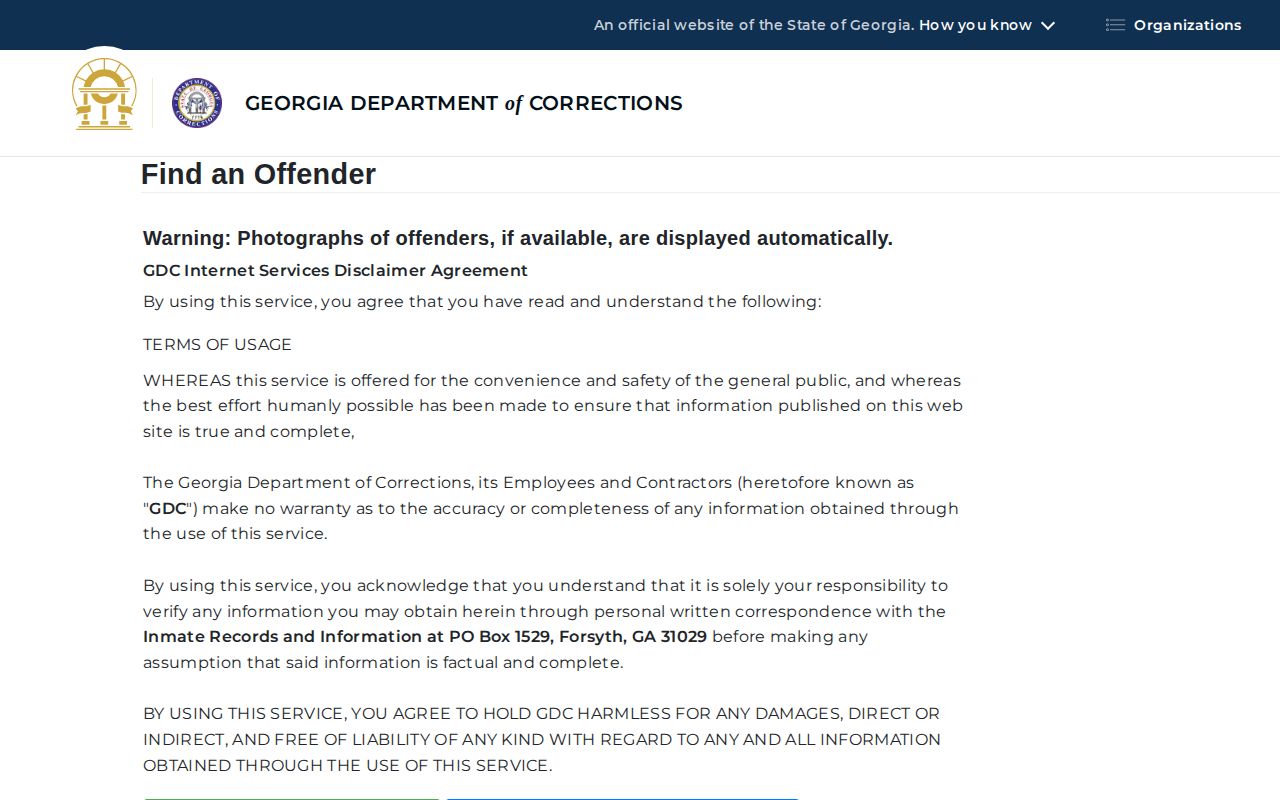
Its status controls are the most direct public route to a Georgia state-prison release record.
Georgia PIC Release Credits
Georgia's Performance Incentive Credit program, known as PIC, can affect eligible state offenders. GDC describes PIC as an incentive reentry process tied to satisfactory progress in programs, work assignments, and good behavior. An eligible person may earn up to 12 points. Those points can potentially reduce a TPM or maximum release date by one to twelve months.
PIC is not a flat credit for every person. Exclusions include death sentences, sentences of two years or less, non-parole-eligible offenses, mandatory minimum sentences such as serious violent felony terms, and life sentences with or without parole. The effect is also described as potential, not automatic. A displayed MRD or TPM should be checked again after program, conduct, or sentence changes.
The GDC PIC explanation gives the official eligibility and point framework illustrated here.
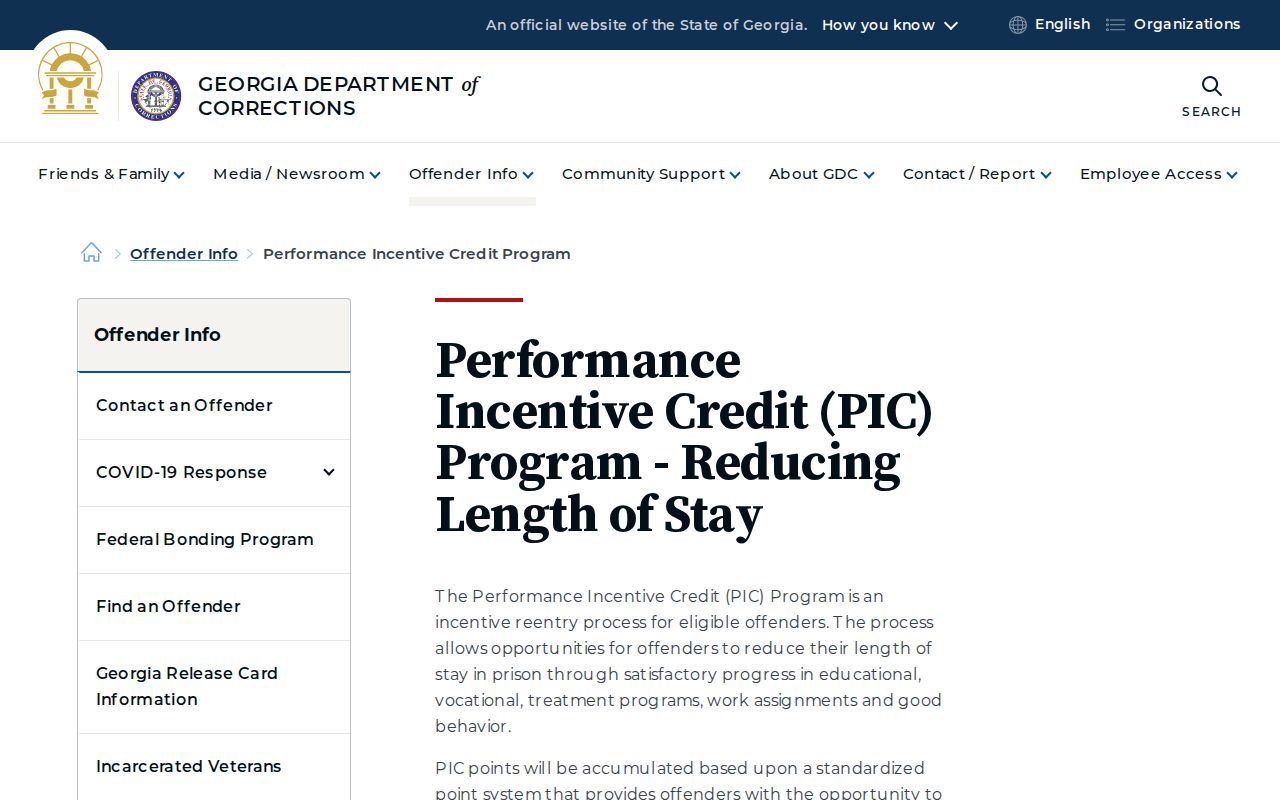
The program can move a qualifying state date, but it does not create a county-jail release calculation.
No Universal Georgia 85 Percent
Georgia's official sources reviewed do not establish a universal rule that every incarcerated person serves 85 percent. Release timing is offense-specific and sentence-specific. Many parole-eligible prisoners reach statutory consideration after one-third of a sentence, but that is only an eligibility point. It does not guarantee parole, and relatively few are granted parole at the first eligible point.
O.C.G.A. 17-10-6.1 restricts early reduction of mandatory minimum terms for serious violent felonies. Certain non-life serious violent felony sentences with qualifying crime dates are not parole eligible. Fourth-or-more felony recidivist sentences and life without parole also fall outside ordinary parole eligibility. Life-sentence rules vary by offense date, including different consideration periods for older and later serious violent felony cases.
The correct question is not “what percentage applies?” Ask which offense, sentence, crime date, mandatory minimum, and parole category control the record. Then compare the sentencing order, GDC calculation, and Board information.
Fayette TPM Is Not Release
A parole-eligible GDC inmate is automatically considered by the State Board of Pardons and Paroles. No application is required. The Board may deny parole or establish a TPM, and it can reconsider a prior decision until release.
At the TPM, the Board completes final review and may set a parole release date. Conduct, required treatment or programs, new information, detainers, and residence-plan verification can affect the result. Misconduct can postpone or cancel the month. A grant can also be withdrawn before release.
Use the Inmate TPM Lookup explanation before opening the search application. Search by inmate number, GDC ID, or personal data. After release, the Parolee Database and Probation & Parole page address supervision status.
Why Fayette Release Dates Change
No single factor controls every date. The record must be read with the sentence and custody history.
| Factor | Possible effect |
|---|---|
| PIC progress | May reduce an eligible TPM or MRD by one to twelve months. |
| Institutional misconduct | Can postpone or cancel a TPM and affect earned incentives. |
| Parole decision | The Board may grant, deny, reconsider, or withdraw a decision before release. |
| Program condition | Required counseling or other programming may need completion first. |
| Residence plan | Parole release may wait for an approved plan. |
| Detainer or warrant | May transfer the person to another authority at the end of GDC custody. |
| Court order | A corrected sentence, revocation, appeal, or credit ruling can change the calculation. |
A detainer is a formal request by another authority to hold or receive the person. It can make a GDC “release” a transfer rather than a return to the community. Confirm destination with the releasing and receiving agencies.
Fayette Jail Sentence Calculations
The public Fayette County inmate lookup does not display a projected release date, release status, or release date. It shows current and recent-booking information such as booking number, booking date, court, charges, and bond. A pretrial detainee normally has no sentence-based release calculation. Bond, court action, and other holds govern the next step.
For a county sentence, the research found no published Fayette good-time formula or weekend-release rule. Do not apply GDC PIC or a guessed percentage. Ask the jail records office or sentencing court for the calculation, including sentence start, credit for time served, any revocation or warrant hold, and the controlling court order. Time served means custody credit recognized toward the sentence.
Call the Fayette County Jail at 770-716-4720 for current routing. Sheriff's Records is 770-716-4790. The county court docket can show public entries, though its online search does not display document images.
Federal Dates for Fayette Cases
A federal sentence does not belong in the Fayette jail or GDC calculation. The BOP Inmate Locator covers federal inmates from 1982 forward and displays a release date and location fields. A result of “Released” or “Not in BOP Custody” means the person is no longer held by BOP, but another agency or supervision system may still apply.
BOP warns that dates can change after sentence review or federal time-credit recalculation. Search by register number when possible, or use name and identifying data. If the person passed from Fayette County Jail to the U.S. Marshals, county records may show only the transfer. The later federal release date comes from BOP and federal case records.
Confirm Fayette Release Timing
Georgia VINE provides custody-status and notification tools. After finding the correct person, register for the available phone, text, or email alert and complete the confirmation steps. A VINE alert is a status notice, not a certified release order.
For GDC and parole cases, the Board's V.I.P. hotline at 1-800-593-9474 can provide current location, parole status or eligibility, maximum or scheduled release date, and a not-in-custody indication when the caller has the required case or GDC identifier. This is distinct from Georgia VINE.
Use VINELink Inmate Search for the registration path, then confirm the actual event with Fayette Jail, GDC, BOP, or the receiving agency. The best evidence is the record maintained by the custodian responsible for that sentence.
Keep the identifying number and date of each check. If two systems disagree, ask whether a transfer, sentence correction, or late update explains the conflict. Court docket entries can establish a new order, but the corrections agency performs the custody calculation. A parole month answers a different question from the sentence end. For the strongest confirmation, compare the sentencing order, current GDC record, Board status, and any notice from the receiving supervision office. Repeat the check near the expected date because conduct, programs, holds, and Board action can change the result before release.
After the expected day passes, switch from forecast fields to completed-status fields. Search inactive GDC records and the recent-release filter, then confirm the destination. That final step separates a true community release from a transfer to another authority.
Public Record Search
Sponsored Results