
Fayette County Parole Versus Probation
Release from custody does not by itself identify the form of supervision. Parole is a conditional release from a Georgia prison sentence. The State Board of Pardons and Paroles makes parole decisions, and the Georgia Department of Community Supervision, or DCS, handles community supervision. Probation is imposed by a court. DCS supervises many felony probation cases, while Fayette County State Court identifies a separate provider for local misdemeanor probation. A person who bonds out is not automatically on either one. Bond secures a later court appearance while the case remains open.
| Record type | Who orders it | Best verification path |
|---|---|---|
| Parole | State Board of Pardons and Paroles after a GDC sentence | Parolee Database, DCS, and the Board's V.I.P. service |
| Felony probation | Superior Court sentence | DCS Griffin field office and Fayette court docket |
| Misdemeanor probation | Fayette County State Court | State Court docket and Judicial Correction Services |
| Bond release | Court and approved bond process | Jail release record and court docket |
The distinction affects which record carries the status. A GDC inactive record may prove that prison custody ended, but it does not establish every current parole term. A county jail disappearance may reflect bond, transfer, or another release reason. The court docket is often essential when probation began without a state prison stay.
- Parole
- Conditional community release before the full prison term ends.
- Probation
- A court-ordered community sentence with stated conditions.
- Discharge
- The formal end of a custody or supervision term.
- Absconder
- A supervised person alleged to have stopped reporting or left supervision without permission.
Check Fayette County Release Supervision
Begin with the source of the sentence. The Georgia Parolee Database is the post-release parole path. The inmate TPM tool is a pre-release planning source, not proof that parole began. For probation, use the Fayette County Court Docket to identify the court, disposition, and sentence, then route the inquiry to DCS or the local State Court provider.
- Confirm the person's full name and whether the case was in Superior, State, or Magistrate Court.
- Check the parolee database when a GDC prison sentence and parole release are possible.
- Review the Fayette County docket for a probation order, revocation, bond, or later disposition.
- Use the DCS field-office search for felony probation or parole office routing.
- Contact the listed office to ask what public status can be confirmed. Use the originating court or agency for an official record.
Georgia VINE supplies custody-status notices, not a full supervision file. The parole board's V.I.P. channel can provide parole status, eligibility, scheduled or maximum release information, and a not-in-custody indication when the caller has the required case or GDC identifier. Those services complement the court and agency record.
Fayette County DCS Release Office
Fayette County is served by the DCS Griffin field office, even though the office is located in Barnesville. Its service area includes Fayette, Pike, Spalding, and Upson counties and the Griffin Judicial Circuit. This state office is the correct routing point for many parolees and felony probationers. It is not the same as the local misdemeanor probation provider.
Georgia DCS Griffin Field Office700 Legacy Park Dr
Barnesville, GA 30204
Phone: 770-358-5047
Fax: 404-937-6358
Monday-Friday, 8:00 a.m.-4:30 p.m.
The official DCS Griffin location page shows the office used to route Fayette County community-supervision matters.
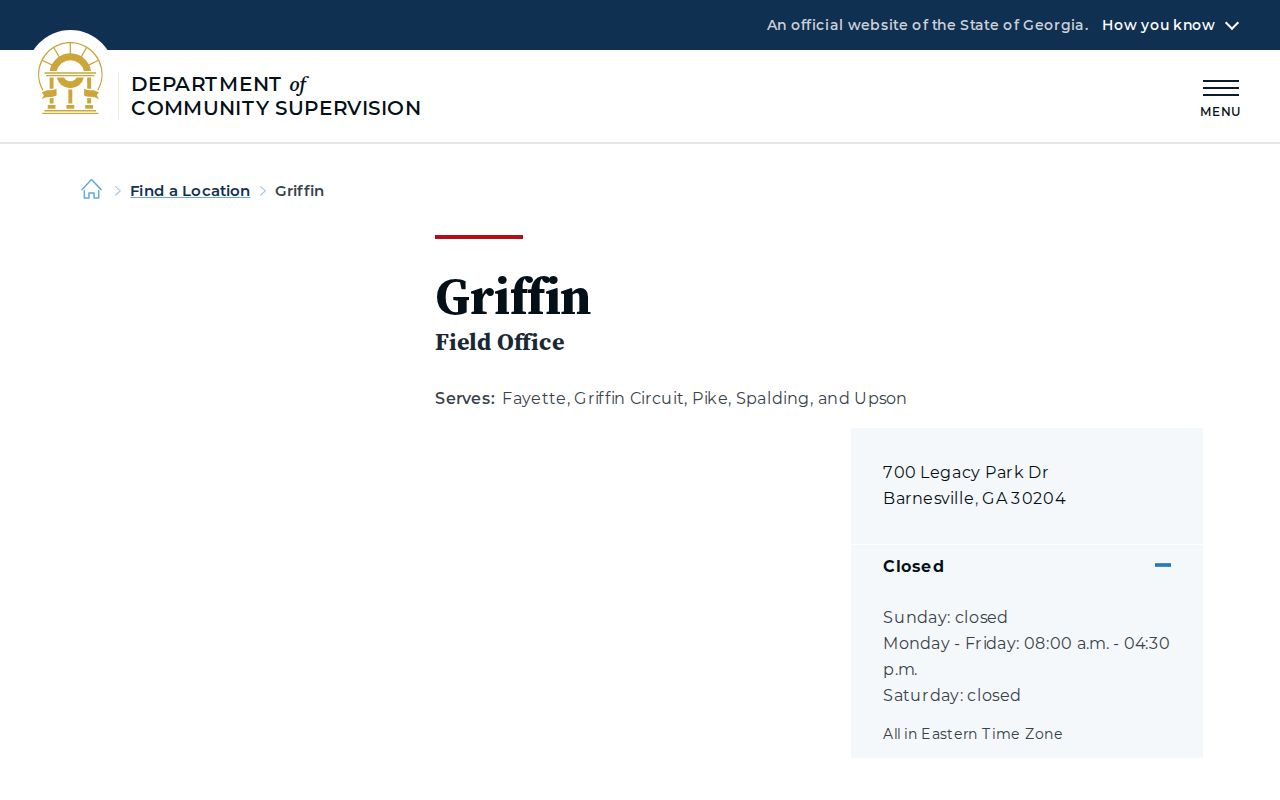
The captured state listing confirms the county service area, office hours, and contact details, which helps prevent a Fayette supervision inquiry from being sent to the wrong DCS office.
For Fayette County State Court probation, the county lists Judicial Correction Services, Inc., at 195 Bradford Square, Fayetteville, GA 30215, phone 770-716-0434. A docket check should come first because the court and case type decide which office is relevant.
Fayette Release Violations and Warrants
Supervision terms can include reporting, approved residence, fees, treatment, travel limits, and compliance with court orders. The exact terms come from the parole certificate or probation sentence. A violation allegation is not the same as a final revocation. For parole, a final revocation hearing determines whether supervision continues or the person returns to prison. Public revocation hearings are a distinct process from the Board's monthly meetings.
No official Fayette County public absconder list was found in the researched Sheriff or DCS sources. Do not infer a warrant from a missing online record. Check the court docket, DCS, the Sheriff's Office, or the issuing court. The Parole Board press-release page carries public monthly meeting notices, agendas, and cancellations, but ordinary offender cases are not considered at those monthly meetings. Individual parole status belongs in the parole tools.
A TPM may be postponed, canceled, or changed before release. After release, alleged misconduct can lead to a warrant and revocation process. Each step creates a different record, so a current agency response should control over an old screenshot or notice.
Fayette County Supervision Discharge
Supervision ends through a formal discharge, expiration, court action, or other authorized agency decision. Leaving jail does not equal discharge, and a GDC inactive status does not necessarily mean all parole or probation duties have ended. Ask the supervising agency or sentencing court for the record that states the end date and status. Georgia's Open Records Act permits requests for existing public records, subject to exemptions, but does not require an office to create a new status summary.
The Fayette County released-inmate search and records page explains how the jail record, GDC result, and court docket fit together. For parole, preserve the parole certificate and discharge notice. For probation, preserve the sentence and any order terminating the case. Those originating records are stronger than a live search result that may later change.
Fayette Release Property Deadline
Post-release tasks can be time sensitive even when they are unrelated to supervision. The Fayette County Sheriff's inmate-information rules say a released or transferred person has ten days to arrange release of property. After that period, the property is disposed of. For a person still held, release to a designee is subject to a different thirty-day admission clock.
Contact the jail promptly about its authorization process. A family member should not assume that DCS or a probation provider controls property left at the jail. This local rule follows the person after a bond release, court release, transfer to GDC, or transfer to another agency.
Fayette Parole Review Records
Most parole-eligible Georgia inmates receive automatic consideration, so no application is required. General statutory eligibility often begins after one-third of a sentence, but that point is not a promise of release. Serious violent felony, recidivist, and life-sentence rules can change or eliminate eligibility. The Board may set a Tentative Parole Month, deny parole, withdraw a grant, or set a later review.
The TPM explanation and lookup helps with the pre-release phase. A TPM means the Board plans a final review in that month. Conduct, programs, detainers, and residence-plan verification may alter the outcome. Once the person is released, shift to the parolee database and DCS rather than treating the old TPM as current proof.
Fayette Release Status Notifications
Georgia VINE is useful when the need is a custody-status change or release notice. Search the person by name or identifier, compare the identifying data, and register for the notification method offered on screen. A release result is a status notice. It is not a certified parole discharge, probation order, or jail release record. Confirm the event with the agency that held or supervised the person.
The State Board of Pardons and Paroles also operates its Victim Information Program, known as V.I.P. Its hotline, 1-800-593-9474, can provide current incarceration location, parole status or eligibility, maximum or scheduled release date, and a not-in-custody indication. The caller uses a six-digit case or EF number or a GDC ID. Registered participants receive release notifications, but V.I.P. does not replace DCS for office routing or the parolee database for a public post-release search.
Choose the channel by purpose. VINE tracks custody and case-status changes. V.I.P. adds Georgia prison and parole information. DCS handles community-supervision routing. Fayette court records establish a probation sentence or later court action. Using all four in the right order avoids treating a notice as a final legal record.
Fayette Parole Eligibility Limits
Georgia does not apply one simple release percentage to every Fayette County prison sentence. O.C.G.A. 17-10-6.1 sets mandatory-minimum and parole restrictions for serious violent felonies. Some non-life sentences for those offenses are not parole eligible. Life-sentence eligibility also varies by the offense and crime date. These limits matter before a person relies on a one-third eligibility point or a rough release estimate.
For eligible cases, O.C.G.A. 42-9-40 is part of the Board's parole-guideline framework. Guidelines help the Board assess a case, but discretion remains. A residence plan, detainer, misconduct, or unmet program condition can change the planned result. The official TPM and parole records should control. When a sentence is unclear, obtain the judgment from the Fayette court docket or clerk, then compare it with the GDC and Board record.
Note: A parole-eligibility date marks possible consideration, not a promised Fayette County release or the start of community supervision.