
Georgia Corrections Release Destinations
GDC serves Fayette County when a felony conviction results in state imprisonment. It is a statewide corrections system, not a local jail or a single facility. When GDC custody ends, the record may reflect sentence discharge, parole release, transfer to a detainer, or another status. A parole release places the person in the community under conditions set by the State Board of Pardons and Paroles and supervision handled through the Georgia Department of Community Supervision.
Sentence discharge means the custodial sentence has ended, though another case or legal duty may remain. A detainer can send the person directly to another county, federal authority, or immigration custodian. A conditional transfer to detainer is therefore not the same as returning home. Read the GDC record with parole status and any receiving-agency information.
The Fayette County Jail lookup covers current county custody and recent county bookings. It cannot establish that a later GDC sentence ended. Likewise, a GDC inactive result does not explain a county-only bond release. Use the system that actually maintained the custody episode.
Confirm Georgia Corrections Releases
The GDC offender search is the main public route for a Fayette state-prison case. Its form supports broad identity and sentence filters.
- Search by GDC ID or case number when known. Otherwise use the full name and compare age, race, gender, offense, and conviction county.
- Select active and inactive scope carefully. “Only Inactive Offenders (Not Currently Incarcerated)” is the clearest route for a person thought to be out of GDC custody.
- Use “Released In The Past 15 Days” for a very recent state release. Use “Max Prison Term Ending Next 15 Days” for an active person nearing the maximum term.
- Review the most recent institution, sentence status, offense, and available photograph. An institution field identifies GDC context, not necessarily current confinement there.
- Confirm the online result with GDC Inmate Records and Information. Then check parole or DCS records if supervision may follow.
The Fayette County released-inmate search explains how to switch between county, state, federal, and immigration sources. Exact identity matching matters because the query supports aliases and many people share names.
GDC Fayette Search Fields
The state query offers more than a basic name box. Its filters help isolate a Fayette conviction and determine whether a result is current, inactive, or recently released.
| Search group | Available details |
|---|---|
| Identity | First, middle, and last name, alias, gender, race, and age range. |
| Physical description | Height, weight, eye and hair color, and scars, marks, or tattoos. |
| Case | Primary offense, conviction county, GDC ID, and case number. |
| Custody | Most recent institution and active, inactive, or combined offender scope. |
| Release timing | Recent release and maximum-term-ending status options. |
| Display | Photo or no-photo results and records-per-page controls. |
The search can list “FAYETTE COUNTY CI” and “FAYETTE COUNTY JAIL” as most recent institution choices. Research did not verify a standalone active public facility for Fayette County CI. Treat that label as a GDC query value and verify the individual record before drawing a facility conclusion.
The official query form shown below includes inactive and recent-release controls.
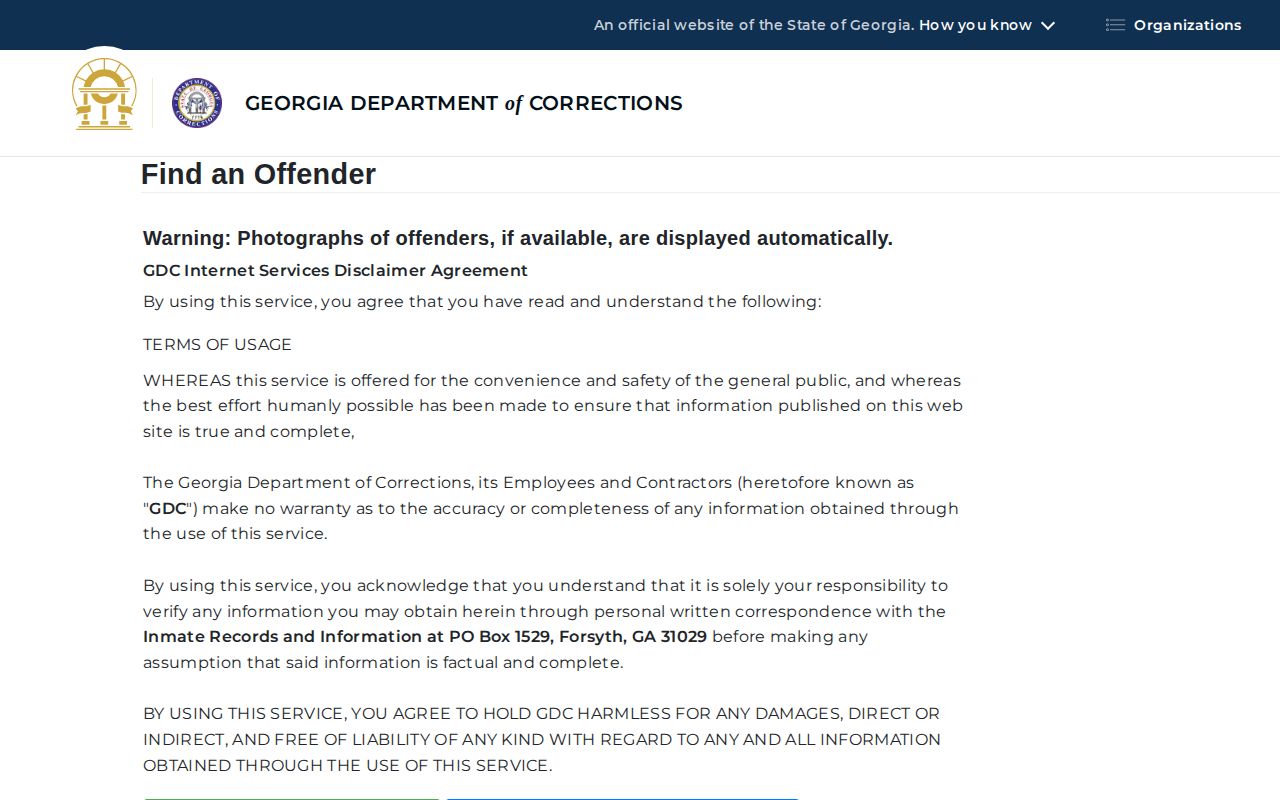
Those sentence-status choices distinguish a state release from a current-institution search.
GDC Release Records Contact
GDC warns that public search information may not be complete and directs users to Inmate Records and Information for verification. The research identifies its mailing address as PO Box 1529, Forsyth, GA 31029. Include the person's full name, GDC ID, and case number when available.
Georgia Department of Corrections
Records routing: Inmate Records and Information
Mail: PO Box 1529, Forsyth, GA 31029
Online: Find an Offender
Georgia's Open Records Act, O.C.G.A. 50-18-70 et seq., governs requests for existing public state records, subject to exemptions. O.C.G.A. 50-18-71 sets a response and production framework of up to three business days when records are available. If they are not available in that period, the agency can describe them and provide a production timeline. This is not a promise that every record arrives unredacted in three days.
Ask for an existing release, discharge, or sentence record rather than a custom report. Georgia agencies do not have to create a compilation that they do not maintain.
Georgia Corrections Fayette Custody
GDC facilities hold people serving state prison sentences. A Fayette County arrest begins locally, but a felony sentence can move the person from Fayette County Jail into statewide custody. From that point, GDC institution and sentence data replace the county roster as the primary custody record.
The “most recent institution” value can be useful even after release. It describes the institution tied to the state record, while inactive scope tells whether GDC currently incarcerates the person. It should not be read as a current address without checking the status field.
- Active offender
- A person currently recorded as incarcerated by GDC.
- Inactive offender
- A person not currently incarcerated by GDC.
- Discharge
- Completion of the state sentence or custody obligation shown by GDC.
- Parole
- Conditional release from prison under Board authority before sentence expiration.
- Detainer
- A request from another authority to hold or receive the person.
GDC Fayette Release Dates
Georgia uses system-specific date terms. GDC's maximum release date is the calculated end of the prison term. The Parole Board's Tentative Parole Month is the month for final parole review. It is not a final release date. The Board's V.I.P. service may report a maximum or scheduled release date.
The Performance Incentive Credit program can potentially reduce an eligible TPM or maximum release date by one to twelve months through satisfactory program progress, work, and conduct. It excludes several categories, including mandatory minimum and non-parole-eligible offenses, life sentences, death sentences, and sentences of two years or less.
Georgia has no universal 85 percent rule in the official materials reviewed. O.C.G.A. 17-10-6.1 restricts sentence reduction for serious violent felony mandatory minimums. Other parole-eligible sentences may reach consideration after one-third, but eligibility is not a release promise. See Projected Release for the full date comparison.
Parole After Georgia Corrections
The State Board of Pardons and Paroles controls parole decisions. Eligible inmates receive automatic consideration without filing an application. The Board may deny parole or set a TPM, and it can change a decision before release. Conduct, program completion, detainers, and residence-plan approval may affect the result.
Before release, use the Inmate TPM Lookup with an inmate number, GDC ID, or personal data. After release, use the Parolee Database to verify parole status. DCS supervises many parolees and felony probationers in the community. Fayette is served by the DCS Griffin field office in Barnesville, not a Fayetteville-named DCS office.
Parole is different from probation. Probation is a court sentence served under conditions and may follow a county-jail term without GDC prison custody. Probation & Parole separates these channels.
Georgia Release Notifications
Georgia VINE supplies custody-status, criminal-case information, and notifications. Search for a person, compare identifying details, then register for an available phone, email, or text alert. Complete the displayed confirmation or PIN step and keep the information needed to change or cancel alerts.
A VINE status notice is not a certified release record. Confirm it with GDC. The Board's V.I.P. hotline at 1-800-593-9474 is a separate state-prison and parole channel. With the required six-digit case or EF number or GDC ID, it may provide current location, parole status or eligibility, maximum or scheduled release date, and a not-in-custody indication.
Use VINELink Inmate Search for alert registration. Multiple channels are useful because an online result can lag a transfer or final processing.
GDC Transfers Beyond Georgia Custody
An inactive GDC result shows that the person is not currently incarcerated by GDC. It does not prove that every custody system released the person. A detainer may lead to another county, BOP, the U.S. Marshals, or ICE.
BOP's locator is the correct federal release-date source and may show “Released” or “Not in BOP Custody.” ICE's Online Detainee Locator System covers immigration detention. Fayette County also publishes quarterly reports tied to ICE detainer notices, making transfer to immigration custody a real local path.
If another agency received the person, seek both ends of the transfer: the GDC record showing departure and the receiving agency's current record. That distinction answers where the person went, not just whether GDC custody ended.
Recent transfers may take time to appear in a receiving system. Preserve the GDC ID, booking number, register number, or A-number that applies, and verify spelling before repeating a search. If the public locator remains unclear, contact the releasing records office, the receiving custodian, counsel, or the court connected to the transfer. Do not infer community release from a blank location alone.
Public Record Search
Sponsored Results